Federal officials believe the Seychelles-based cryptocurrency exchange handled transactions for Canada’s most prolific darknet marketplaces, according to court records.
Records obtained by the IJF(investigative journalism foundation) indicate the government’s anti-money laundering watchdog believes the cryptocurrency exchange Pekin Global Limited( KuCoin), helped its users buy products from Canadian HeadQuarters and We The North Market, Canada-based online bazaars that traded in drugs, stolen data and other illegal products.
Those records were filed after the Financial Transactions and Reports Analysis Centre of Canada (Fintrac) issued a then-record $19.5 million penalty to KuCoin in July 2025.
KuCoin, one of the most-used cryptocurrency exchanges in the world, has appealed that penalty, which it said was based on erroneous information and is disproportionately large. The exchange claimed the penalty came after years of no contact from Fintrac, which it says first got in touch to express concerns in 2021.
“Fintrac’s approach did not respect principles of transparency, fairness or documentation as Fintrac did not provide KuCoin with notice or an opportunity to make submissions prior to imposing [penalties],” KuCoin’s federal court appeal said.
When it issued the penalty against KuCoin, the agency said the exchange had failed to register and report large cryptocurrency transactions. They also claimed KuCoin failed to report transactions with a possible nexus to money laundering or terrorist financing.
Many of the documents Fintrac filed in court are heavily redacted. But together with KuCoin’s appeal, they shed new light on the contents of the watchdog’s investigation and why it issued such a large penalty.
We The North and Canadian HeadQuarters
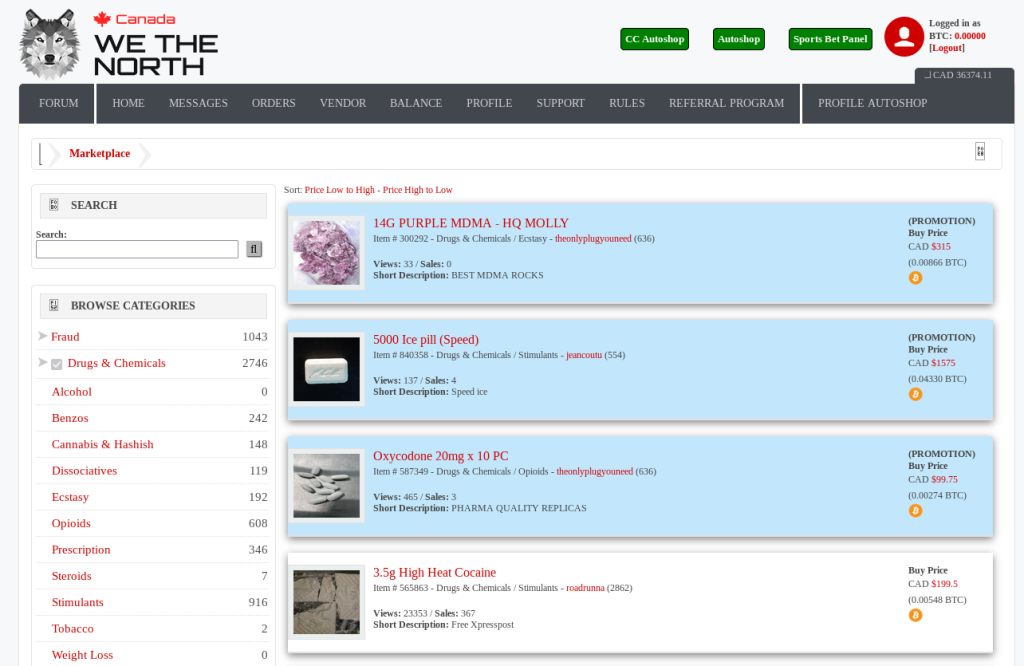
KuCoin’s appeal said Fintrac accused the exchange of failing to report 33 suspicious transactions between June 2021 and December 2024. Those apparently included transactions with Canadian HeadQuarters and We The North, which SFU criminology professor Richard Frank described as examples of aiding darknet marketplaces,
He also said that while most darknet markets primarily sell drugs, only 23 per cent of listings of the roughly 3,200 products on We The North in 2023 were narcotics. The market seemed to sell mostly stolen data, including passwords and hacked accounts.
In 2022, the Canadian HeadQuarters was taken offline after RCMP arrested 22-year-old Chris Tyrone Dracos, a Laval man they accused of operating the website.
Quebec’s director of criminal and penal prosecutions said Dracos pleaded guilty to credit card theft and to counselling other people to commit an offence.
Dracos served 90 days in jail, plus two years probation.
Dracos’ former lawyer, Eric Sutton, told the IJF “he will not partake in any interview on the matter.”
Dracos also later agreed to pay the government $40,000 in an agreement with Canada’s telecommunications regulator, which alleged he had violated the country’s anti-spam legislation.
Frank said such marketplaces and the exchanges helping them sell are rarely tackled by police, who usually prioritize physical street-level drug trafficking.
“I understand both are bad and both have to be combatted, but police only have limited resources,” Frank said.
Frank said that We the North had arisen sometime after the collapse of Canadian HeadQuarters and had apparently supplanted it in the illegal darknet trade. KuCoin’s notice of appeal said it had also been accused of facilitating transactions related to “Fake ID Canada.”